Helping children learn Twi away from Ghana.
A child does not need to live in Ghana for Twi to become part of everyday life. But the language usually needs more than occasional lessons. It needs people, routines, reasons to answer and moments in which understanding Twi helps the child participate in family life.
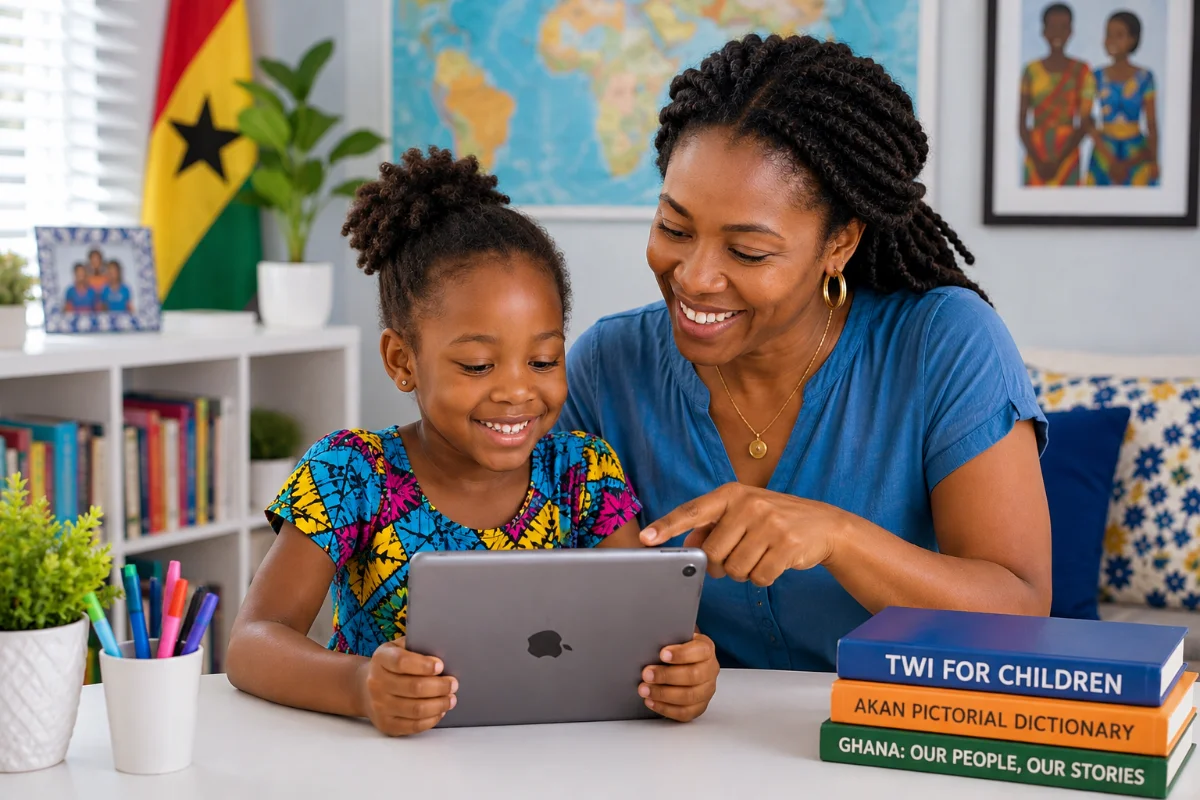
Do not make Twi something a child encounters only during a scheduled lesson. Give the language small, predictable jobs throughout the week: greeting Grandma, coming to eat, answering a parent, joining a family call, saying thank you, talking about the day or preparing for a visit to Ghana.
The real challenge is not exposure. It is use.
Many children growing up outside Ghana hear some Twi. Parents may speak it to each other, grandparents may use it on the phone, Ghanaian adults may use it at church or family gatherings, and music or videos may bring the language into the home. Yet hearing a language around you is not the same as learning to participate in it.
A common pattern is that a child understands more Twi than they are willing or able to speak. A parent asks something in Twi; the child understands and answers in English. That is not evidence that nothing has been learned. It shows that comprehension and production are developing at different speeds. The useful question becomes: how do we make answering in Twi easier, more normal and more worthwhile?
Instead of beginning with “My child must speak Twi fluently,” begin with: “There should be parts of our family life that my child can comfortably do in Twi.”
Make Twi ordinary before trying to make it impressive
If every use of Twi becomes a lesson, correction or performance, the language can begin to feel like homework. Everyday repetition is often more useful. Choose phrases that naturally belong to things your family already does.
Morning, meals, leaving the house, returning home, bedtime and family calls are powerful because they happen again and again. The child does not have to remember a random vocabulary list; the situation itself becomes the reminder.
Did you sleep well?
Yes, I slept well.
Come and eat breakfast.
I am coming.
These are examples of the kind of home-language exchange included in Nkyea Twi's family material. Their value is not that a family must use these exact four sentences. The principle is to choose language that has a recurring place in your own household.
Build little “Twi islands” in the day
Families sometimes set a rule such as “We will speak only Twi at home from now on.” That can work in some households, but for others it is too large a change and quickly collapses. A smaller approach is to create predictable Twi islands: moments when everyone already knows that Twi is the normal language.
One routine
Make breakfast greetings Twi. Keep it going until the child can understand and answer without treating it as an exercise.
One more situation
Add bedtime, the drive to school, Saturday chores or the weekly call to a relative. The language grows with the family's real life.
Give the child something useful to say back
Adults can accidentally dominate heritage-language learning. The parent knows the language, so the parent speaks in complete sentences while the child is expected to somehow construct an answer. Make the child's side of the conversation easier.
Teach short responses that unlock participation. If a child hears the same question regularly, teach the likely answers at the same time.
Notice that this is not grammar practice disguised as family conversation. Each line lets the child do something: answer a caring question, find Grandma, understand where somebody is, or respond when called.
Do not punish the English answer
If a child understands a Twi question but answers in English, there is still useful comprehension there. You can model the Twi response without turning the moment into a confrontation.
Asks the familiar question in Twi.
Answers in English.
Gives the short Twi version the child could use, then lets the conversation continue.
Recasting the answer this way keeps the language available without making every mistake the centre of attention. There are times for direct correction, especially when a learner actively wants it, but successful communication should not constantly be interrupted in pursuit of perfect grammar.
Give the language a person
“Learn Twi because it is your culture” can be meaningful to an adult, but it may be too abstract for a child. “Learn this because this is how you can talk with Grandma” is concrete.
Grandparents, aunties, uncles, cousins, family friends and trusted members of a Ghanaian community can give Twi a social identity. The language becomes associated with particular voices, jokes, greetings, stories and relationships.
“Where is Grandma?” is easier to make meaningful when Nana is an actual person the child knows, calls and wants to see.
Use family calls differently
A video call to Ghana can become a recurring language event without becoming a class. Before the call, prepare two or three things the child can say and two questions they may hear. During the call, let the child use them. Afterwards, briefly revisit what they understood.
Choose one greeting, one answer and one question the child can use.
Let the relative respond naturally. Avoid feeding the child every word unless they need help.
Ask what they recognised. Practise only the parts worth carrying into the next call.
Connect Twi to Ghana before the plane lands
A visit to Ghana can create a powerful reason to learn, but preparation matters. If the child first encounters all the pressure to speak Twi after arriving, they may become self-conscious precisely when the family wants them to participate.
Before the trip, rehearse situations they are actually likely to experience: greeting older relatives, being asked whether they have eaten, being called to come, sitting with family, attending church, visiting a market or talking with cousins.
Practise the first afternoon with relatives.
What might Grandma say? What can the child answer? How can they ask where someone is? What will they hear when food is ready? A handful of familiar exchanges can make arrival feel much less linguistically overwhelming.
Let community widen the child's idea of who speaks Twi
If Twi exists only between a child and one parent, the child can easily understand it as “Mum's language” or “Dad's language.” Community changes that. Ghanaian cultural organisations, family gatherings, churches and other appropriate community settings can show that the language belongs to a wider network of people.
The goal is not to force every community event to become a lesson. It is to let the child hear Twi used for real purposes by different people and, when possible, have small opportunities to participate.
Use stories, food, music and family history—but keep conversation in the centre
Culture can make language emotionally memorable. A family story can introduce kinship terms. Cooking can create repeated instructions and food vocabulary. Music can make sounds and expressions familiar. Photographs can lead to conversations about who people are and where they live.
But cultural exposure and language production are not identical. A child can love Ghanaian food and music without becoming comfortable speaking Twi. Use those interests as doors into conversation: ask a small question, teach a useful response and revisit it later.
Choose consistency over intensity
Heritage-language learning is a long project. A dramatic weekend of Twi followed by three silent weeks is less useful than a few phrases that return every day. Parents also need a routine they can realistically sustain when school, work and family life become busy.
Keep greetings, meals and other established routines in Twi.
Listen to and practise a few phrases the child is currently trying to use.
Use Twi with a relative, family friend or appropriate community connection.
Expand only after older phrases are beginning to feel ordinary.
How Nkyea Twi can fit into a diaspora family's routine
An app cannot create a family language environment by itself. It cannot replace the emotional value of speaking with a grandparent, the spontaneity of a cousin's reply or the experience of hearing Twi around a family gathering. Those are strengths of people and community.
Nkyea Twi can instead serve as a structured practice tool between those interactions. Its existing family-oriented material includes a Reconnect With Family Mission built around greeting relatives, explaining who you are, talking at home, showing care, faith conversations and family customs.
Practice can support the relationship, rather than replace it.
Learners can practise language connected to relatives, home life, meals, greetings, care and cultural interaction.
Mission material includes phrases the learner may say, phrases they may hear and short responses they can give next.
Audio gives the learner a spoken model so practice does not depend only on reading Twi from the screen.
Learners can say phrases aloud and use automated feedback as practice guidance rather than treating a score as a perfect judgement of how they speak.
Flashcards, Favorites and repeated review can help families revisit useful phrases instead of continually adding new material.
A parent can choose a phrase from the app, practise it with the child and then deliberately use the same phrase later in an actual household or family conversation.
For children, the strongest use of a learning tool may therefore happen away from the screen: practise something briefly, then give that language a job in real family life.
What progress can look like
Progress does not have to begin with long, grammatically complete conversations. A child may move through several useful stages: first recognising a phrase, then answering in English, then giving a one-word Twi response, then using a short phrase without prompting, and eventually beginning an interaction themselves.
Understands a familiar Twi phrase.
Responds, even if the first response is in English.
Answers in Twi with a word or short familiar phrase.
Uses Twi without prompting in a familiar routine.
Starts a small interaction or carries Twi into a new situation.
That progression is worth noticing. If adults recognise only the final stage as “speaking Twi,” they may miss the learning that is already happening.
A practical family target
Instead of asking whether your child is “fluent yet,” see whether Twi is gradually gaining territory in ordinary life.
A useful early target is for the child to be able to:
- recognise and return familiar greetings;
- answer two or three recurring household questions in Twi;
- understand a few common meal-time or home instructions;
- ask a relative one simple question;
- use Twi during part of a call with a grandparent or other relative;
- say a few phrases without reading from a screen;
- recognise some of the language they are likely to hear when visiting family in Ghana; and
- experience speaking Twi as participation—not as a test they are constantly failing.
The long-term goal may be confident conversation. But confident conversation is built from hundreds of smaller moments in which the child discovers: I understood that. I knew what to say. They understood me.
Practise a phrase today. Give it a real job tomorrow.
Nkyea Twi includes native audio, speaking practice, family-oriented Missions, flashcards and review tools that can support practice between real conversations with parents, relatives and community.