Learning Twi before meeting your partner's family.
You do not need advanced Twi to make a thoughtful first impression. A small number of well-practised greetings, responses and family phrases can help you enter the conversation respectfully instead of standing outside it.
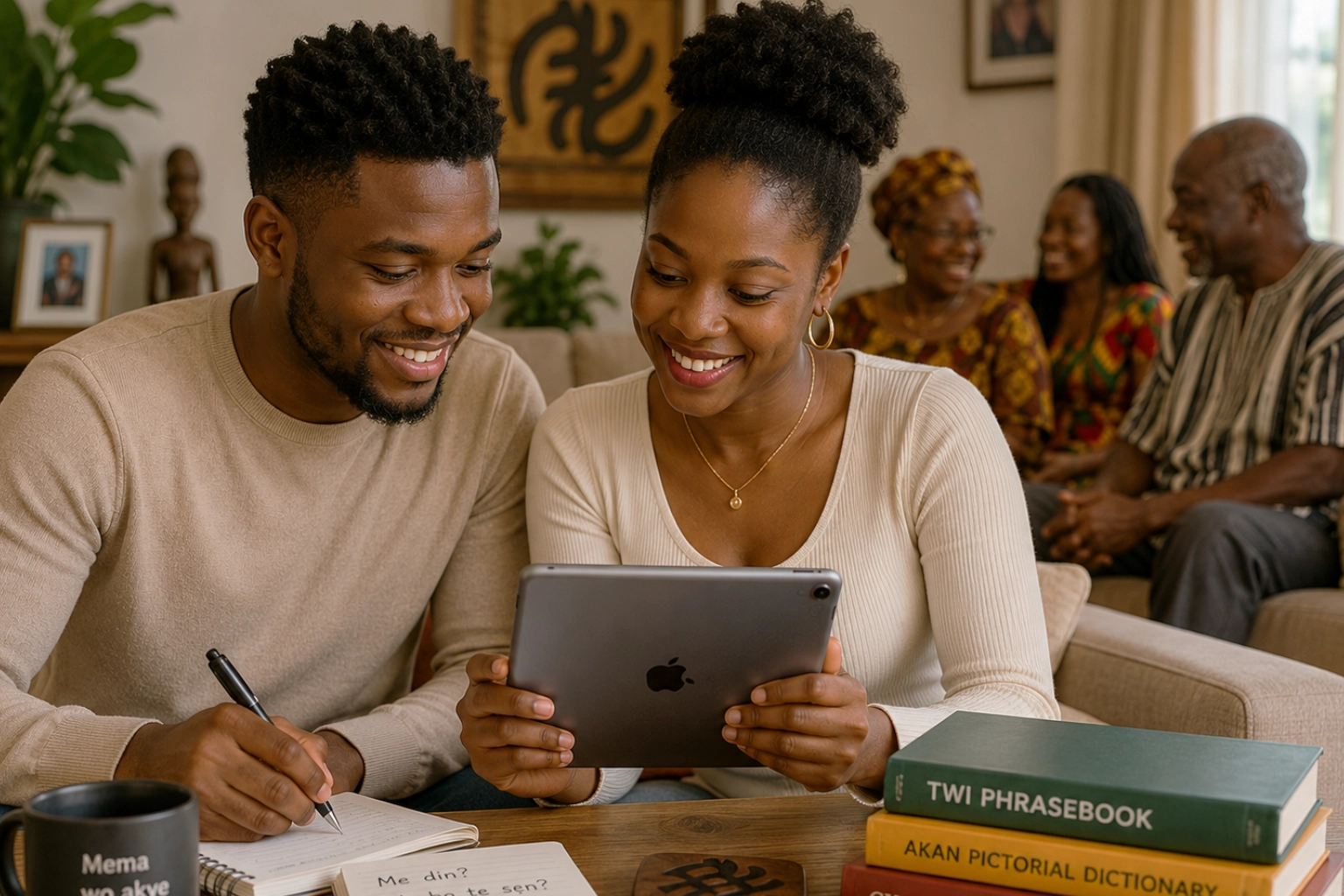
Do not try to become fluent before the visit. Prepare for the first ten minutes, the questions you are most likely to hear, the hospitality that may follow and the moment when you leave. That is a much smaller—and much more practical—language problem.
Think about the visit as a sequence, not a vocabulary test
Meeting a partner's family can make a learner feel that they need to know everything at once. In reality, the first visit usually contains a series of predictable moments: you arrive, greet people, are welcomed, sit down, introduce yourself, answer questions, talk, perhaps eat or drink something, thank your hosts and eventually say goodbye.
That predictability is useful. Instead of memorising unrelated words, prepare language for those moments. The aim is not to perform Twi for the family. It is to understand enough of the social rhythm that you can participate with warmth and respect.
Greet before launching into conversation.
Recognise the welcome and answer naturally.
Be ready for simple questions about yourself.
Follow common family and hospitality exchanges.
Thank people and close the visit warmly.
Start with respect, because the greeting comes before the story
When you meet older relatives, a respectful greeting gives you something useful to do immediately. It is better to deliver one appropriate greeting calmly than to rush through several memorised sentences simply to demonstrate how much Twi you have learned.
Good morning, everyone.
Good morning, Grandmother/Grandfather.
Welcome.
Thank you.
These are examples from family-oriented material in Nkyea Twi. The important lesson is not to treat “hello” as a universal script. Learn who you are addressing, roughly when you will arrive and what response is likely to come back.
Ask your partner who is likely to be there. If you know you are meeting parents, grandparents, aunties, uncles or several relatives together, you can practise for the actual room you will enter rather than an imaginary conversation.
Learn what happens after “Akwaaba”
A learner can practise an opening greeting perfectly and still become lost five seconds later. The solution is to learn exchanges rather than isolated lines.
When you practise the likely reply as part of the same scene, the conversation stops feeling like a surprise. This is especially useful for a first meeting, where nerves can make even familiar language harder to recognise.
Prepare to introduce yourself—but do not memorise a speech
Your partner's family may naturally want to know more about you. You do not need a long biography in Twi. Prepare a few pieces of information that can survive interruption: your name, where you are from, where you live, what you do and perhaps how long you have known your partner.
Wo din de sɛn?
What is your name?
Me din de Michael.
My name is Michael. Replace the example name with your own.
The advantage of practising questions as well as answers is that you learn to recognise the cue. Knowing how to say your name is much more useful when you can also hear that somebody has just asked for it.
Expect family questions to feel more personal than small talk
Family conversation does not always follow the same boundaries as a formal introduction. People may ask about your family, work, where you live, your background or your relationship. You do not need to predict every question. Learn enough conversational structure to recognise the subject and answer the questions you are comfortable answering.
“How is the family?” is useful because it moves attention away from you and shows interest in the people you are meeting.
Respect is also knowing how to ask, not only what to say
Politeness often appears in small moments: entering a room, interrupting somebody, asking for attention or admitting that you do not understand. One phrase can therefore do a surprising amount of work.
Excuse me / please, depending on the situation.
In Nkyea Twi's family-culture material, this phrase is practised for getting someone's attention, interrupting politely or passing someone. Learn it as something you can use, not merely something you can translate.
Do not panic when people answer at natural speed
Real family conversation will not sound exactly like a slow practice recording. Different voices, overlapping conversation, laughter and unfamiliar phrasing can make the first visit difficult even if you prepared carefully.
Your job is not to understand every word. Listen for phrases you know, names, repeated words and the immediate context. If everyone is looking at you after somebody asks a question, your partner can help. There is nothing useful about pretending to understand and then answering a completely different question.
“I am still learning.” It can lower the pressure while also making clear that your Twi is a work in progress.
Hospitality deserves its own practice
Sitting down, being offered food or drink, being encouraged to feel at home and thanking the person who served you are ordinary parts of a family visit. They are worth practising because they combine language with immediate social action.
Listen for familiar language connected to sitting, eating or drinking.
You do not need a complicated sentence when a simple polite answer will do.
Medaase is worth being able to say comfortably rather than mechanically.
Do not turn the visit into a demonstration of your Twi
Learning the family's language is meaningful because it can help you connect. That purpose is weakened if every moment becomes an opportunity to display what you have memorised. Use Twi where you can use it naturally. Listen when others speak. Switch languages when necessary. Let the conversation matter more than proving your level.
The strongest first impression may come from a combination of things: greeting people appropriately, listening, showing interest, thanking your hosts, accepting correction with good humour and trying again. Twi supports those behaviours; it does not replace them.
Let your partner become your rehearsal partner
Your partner knows far more about the particular family meeting than a generic phrase list does. Use that knowledge. Ask them to recreate the first few minutes with you before the visit.
Your partner plays the relative. Practise entering, greeting and hearing the response.
Practise three likely questions without being told which one is coming next.
Practise being welcomed, invited to sit and offered something.
Practise thanking the family and ending the visit without searching for words.
Practise leaving as carefully as arriving
Learners often spend all their preparation on greetings and introductions. But the goodbye is another predictable moment, and it is an easy place to leave the family with warmth.
See you later / we will meet again.
Stay well.
Go well.
These parting phrases are also part of Nkyea Twi's greetings material. As with the arrival, the point is to know which phrase belongs to which side of the exchange rather than memorising several translations of “goodbye.”
A simple seven-day preparation plan
If the meeting is approaching, a short focused plan is more realistic than trying to work through an entire language course.
Greetings. Learn the greeting appropriate to when you expect to arrive.
Responses. Practise what you may hear immediately after greeting.
Introduction. Practise your name and a few basic facts about yourself.
Family conversation. Prepare a few likely questions and one question you can ask.
Hospitality. Practise sitting, food, drink, thanks and polite attention-getting.
Full rehearsal. Ask your partner to role-play the visit at natural speed.
Light review. Review the phrases you already know instead of cramming new ones.
How Nkyea Twi can fit into this preparation
No app can tell you exactly what your partner's mother, father or grandmother will say when you meet. Family personalities, dialect, language preference and the circumstances of the visit matter. Your partner remains the best source for those specifics.
Nkyea Twi can provide structured practice around the kinds of situations that overlap with a family meeting. Its Reconnect With Family Mission includes greeting relatives, explaining who you are, talking at home, showing care, faith conversations and family customs.
Prepare for an interaction, not just a list of words.
Practise greetings for relatives and elders, along with the responses you are likely to hear.
Practise common questions such as Wo din de sɛn? and the answers that let you explain who you are.
Mission phrases distinguish between what the learner says, what the learner may hear and what the learner can say in response.
Listen repeatedly so the written phrase becomes connected to a spoken voice before the family meeting.
Say phrases aloud rather than recognising them silently. Automated feedback can provide practice guidance while you build confidence.
Use Favorites and review tools to keep a small “meeting the family” set instead of trying to learn every available phrase.
What should you actually know before you walk through the door?
A practical first-meeting target is being able to:
- greet the family appropriately for the time of day;
- address an older relative respectfully;
- recognise a welcome and say thank you;
- understand an invitation to sit;
- say your name and recognise the question asking for it;
- ask how the family is doing;
- use a polite phrase such as Mepa wo kyɛw when you need attention;
- say that you are still learning if the conversation becomes difficult;
- recognise a few common hospitality phrases; and
- end the visit with a warm, appropriate goodbye.
That is not fluency. It is something more immediately useful: enough language to enter an important family moment with preparation, listen for what comes back and show that you are willing to meet people part of the way in their language.
Learn the Twi you are likely to need before the introduction begins.
Use native audio, speaking practice, family-oriented Missions and smart review inside Nkyea Twi, then rehearse the real visit with your partner.