Why Twi pronunciation can be difficult for English speakers.
The challenge is often not intelligence or effort. English-speaking learners already have a highly practised sound system, and familiar-looking letters can make the brain reach for English habits before it has learned what the Twi word actually sounds like.
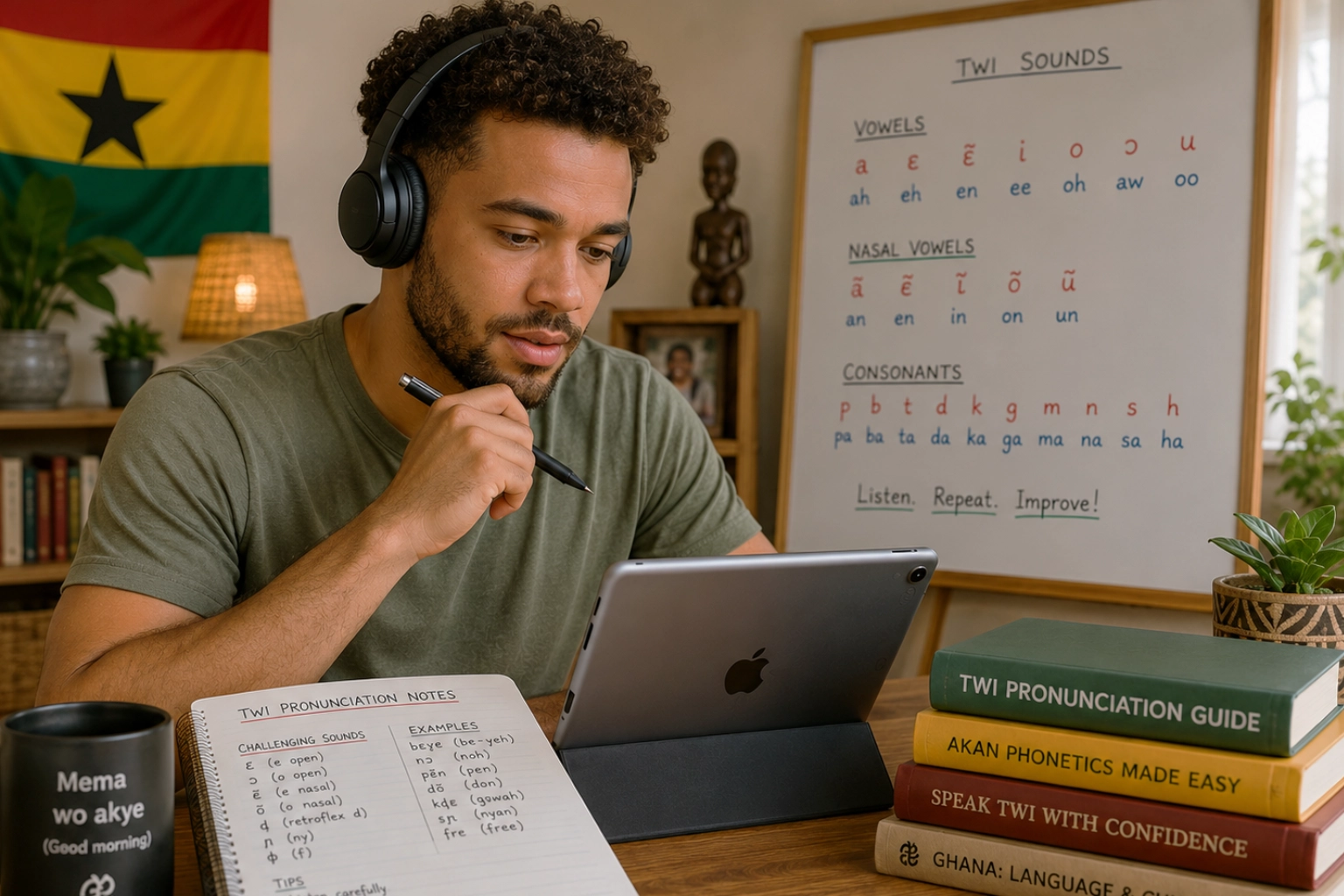
When an English speaker sees a Twi word, the spelling can feel familiar before the sound is familiar. That creates a temptation to pronounce the word from the page. A better sequence is often: hear it → notice it → imitate it → compare it → repeat it.
You are not starting pronunciation from zero
An adult English speaker already has years of automatic habits for turning letters into sounds. That is useful when reading English, but it can interfere when the same-looking letter belongs to a different sound pattern in another language. The learner may not consciously decide to use an English pronunciation; it simply arrives first because it is already automatic.
This is why pronunciation practice should not begin with the assumption that a learner merely needs to “try harder.” The first task is to build a new sound target clearly enough that the learner can hear the difference between what they expected and what a Twi speaker actually produced.
Listen before deciding how the spelling should sound.
Identify the part that differs from your English expectation.
Copy the whole phrase rather than assembling it letter by letter.
Listen again and notice where your attempt changes.
Build the movement until it becomes less deliberate.
The Twi alphabet contains familiar letters—and two that English does not use
Written Asante Twi commonly uses the vowel letters a, e, ɛ, i, o, ɔ, u. For an English speaker, ɛ and ɔ immediately stand out because they are not ordinary English alphabet letters. But the more important lesson is that even the familiar letters should not automatically be assigned whatever sound English spelling suggests.
Treat ɛ as its own vowel symbol. Learn its sound from spoken examples instead of deciding that it is merely a decorative version of an English letter.
Ɔ also represents its own vowel category. Seeing the distinction in writing helps, but hearing it repeatedly is what gives the symbol a reliable sound in your mind.
This matters because a learner can read the right letters while still hearing the word internally through English. Pronunciation improves when the Twi spelling begins to trigger a Twi sound directly, rather than first passing through an English approximation.
A phrase can look more difficult than it sounds
Consider a phrase already used throughout Nkyea Twi:
Good morning.
Nkyea Twi's product material pairs practical phrases with native Twi audio, slower playback and phonetic support. Those tools are most useful when they work together: the audio establishes the target, slower playback reveals detail, and the phonetic guide can help a learner remember what they heard.
Phonetic spelling is scaffolding, not the language itself
A pronunciation guide written with English-friendly syllables can be extremely helpful at the beginning. It can stop a learner from making a wild guess and can remind them how an unfamiliar word was broken up. But phonetic hints have a limitation: they are still being interpreted through the learner's existing reading habits.
Use all three to decode an unfamiliar phrase.
The learner may pronounce the guide with English sounds and practise the approximation repeatedly.
The goal, therefore, is eventually to need the guide less. When you see a familiar Twi phrase, you want to remember the voice that said it—not reconstruct it from an English-looking pronunciation every time.
English spelling trains learners to tolerate inconsistency
English readers are accustomed to the same letter behaving differently in different words and to groups of letters whose pronunciation cannot be predicted simply by looking at them. That history shapes how an English-speaking learner approaches unfamiliar text: there is a strong tendency to guess from familiar spelling patterns.
With Twi, that instinct can become a distraction. Instead of asking which English word a Twi spelling resembles, attach the Twi spelling to the Twi audio. You are creating a new relationship between symbol and sound.
Replace “How would an English speaker pronounce this spelling?” with “What sound does this spelling represent in the Twi phrase I just heard?”
Some of the difficulty is in the transition between sounds
Learners often focus on individual vowels and consonants, but natural speech is not a row of isolated sounds. The mouth has to move from one sound to the next while keeping the phrase connected. A learner may pronounce every part slowly and still sound hesitant when the parts are joined.
How is the family?
This phrase appears in Nkyea Twi's family material. It is useful pronunciation practice precisely because it is real language: you are learning sound, rhythm and a phrase you could actually use.
Slow audio is a microscope, not the destination
Slower playback can reveal a sound that disappeared when the phrase felt too fast. It can help a learner notice syllables, hear a vowel more clearly or work out where one word ends and another begins.
But slow speech should not become the only model. If you practise exclusively against an unnaturally slow version, you can become comfortable with a rhythm that disappears in ordinary conversation. After using slow playback to inspect the phrase, return to normal speed and try to imitate the complete movement.
Hear the phrase as a complete spoken unit first.
Inspect the part you could not hear clearly.
Give your mouth time to find the movement.
Reconnect the detail to natural timing.
Listening and speaking are different skills
Recognition can create false confidence. You may hear a phrase and immediately know what it means, yet discover that you cannot produce it cleanly when the audio stops. Listening asks you to recognise a pattern. Speaking asks you to recreate that pattern with your own breath, tongue, lips, jaw, timing and memory.
The sound is supplied to you and you recognise it.
You must retrieve the phrase and create the sound yourself.
That gap is normal in language learning. It is also why pronunciation practice has to include moments when the learner actually speaks.
Use short phrases to diagnose specific problems
Long sentences create too many variables at once. When pronunciation is difficult, work with a short, useful phrase and identify one feature to improve.
Thank you.
Good for practising a complete everyday word until it comes out without hesitation.Please / excuse me.
Useful for hearing how a familiar-looking spelling and the Twi sound need to be connected through audio.May God bless you.
A phrase in Nkyea's faith material that gives the learner a real context for practising ɔ.Do not chase an English accent—or panic about having one
The practical objective is not to erase every trace of where you come from. It is to make your Twi increasingly clear, recognisable and comfortable to understand. Accent and intelligibility are not identical. A learner can retain features of an English-speaking accent while becoming much more accurate in important Twi sound distinctions and phrase rhythm.
That is a healthier target than trying to imitate a vague idea of “sounding native” immediately. Work on the features that repeatedly interfere with the words you want to say. Improvement becomes concrete: this vowel is clearer, this phrase is smoother, this word no longer needs three attempts.
Recording yourself changes what you notice
While you are speaking, part of your attention is occupied with remembering the phrase and moving your mouth. That makes self-evaluation difficult. Recording an attempt and listening back separates production from evaluation.
Play the reference phrase several times.
Repeat it without talking over the reference.
Capture one natural attempt rather than ten rehearsed ones.
Choose one difference you can actually hear.
Change that one feature and compare again.
Avoid trying to repair five things at once. Pronunciation practice becomes much more manageable when each repetition has a purpose.
Rhythm matters because people speak phrases, not dictionaries
A learner who studies only isolated words may become good at pronouncing those words in isolation while still struggling when they appear in ordinary speech. Useful pronunciation practice therefore moves through three levels:
Can you hear the feature you are trying to learn?
Can you produce it reliably inside a real Twi word?
Can you keep it when the word is surrounded by natural speech?
A practical ten-minute pronunciation session
Pronunciation does not require an hour-long lesson every day. A focused ten minutes can be more useful than a long session of passive listening.
Listen. Choose two or three useful phrases and hear them repeatedly at normal speed.
Inspect. Slow down the phrase or use phonetic support only where something is unclear.
Imitate. Speak after the model, concentrating on one sound or transition at a time.
Compare. Record yourself or use speaking feedback and identify one difference.
Finish naturally. Say the phrases again at normal conversational speed without reading every syllable.
Where Nkyea Twi fits into pronunciation practice
Nkyea Twi is one tool for this kind of work, not a substitute for interaction with fluent speakers, a skilled teacher or sustained listening to natural Twi. Those sources can provide nuance, correction and variation that automated practice cannot fully reproduce.
The app is useful because it brings several parts of the pronunciation loop together. Its current product material describes native Twi audio, slower playback, phonetic support and a “Speak this phrase” feature that lets the learner produce the phrase rather than remain passive.
A repeatable pronunciation loop.
Work with practical language instead of practising sounds only in isolation.
Establish a spoken target before allowing English reading habits to decide the pronunciation.
Use slower playback when you need to inspect a difficult section, then return to normal speed.
Let the guide help decode the phrase, while keeping the recorded audio as the primary sound model.
Turn on the microphone and produce the language yourself instead of stopping at recognition.
Automated speaking feedback can help identify attempts worth repeating, but it should be treated as practice guidance rather than an infallible judgement of accent or pronunciation.
How to know that your pronunciation is improving
Improvement is not only “I sound more native.” Look for smaller, observable changes. You need fewer repetitions before hearing the difference. You can say a phrase without reading the phonetic guide. You remain accurate when you speed up. A familiar phrase comes out automatically. A Twi speaker understands you without asking you to repeat it.
The page should eventually disappear
At the beginning, spelling, phonetic hints and explanations are useful because they help you decode what you are hearing. But successful pronunciation eventually becomes less visual. You hear a phrase, know what it means and your mouth knows approximately what to do.
That is the direction to work toward: not memorising increasingly elaborate pronunciation instructions, but building a strong enough connection between meaning, sound and movement that the Twi phrase becomes speakable.
When a Twi phrase is difficult to pronounce:
- listen before guessing from the spelling;
- identify one sound or transition that is causing trouble;
- use slow playback to inspect it;
- use phonetic support as a guide, not as a replacement for audio;
- repeat the whole phrase, not only isolated letters;
- record or check your own attempt;
- return to normal-speed speech; and
- use the phrase in a real interaction as soon as you can.
Hear the phrase. Slow it down. Say it yourself. Try again.
Use native Twi audio, phonetic support, slower listening and speaking practice inside Nkyea Twi, then take those phrases into real conversations.