Twi for Beginners: How to Start Speaking Twi.
You do not need to understand all of Twi grammar before you start speaking. Begin with useful phrases, learn how they sound and practise them in the situations where you are most likely to need them.
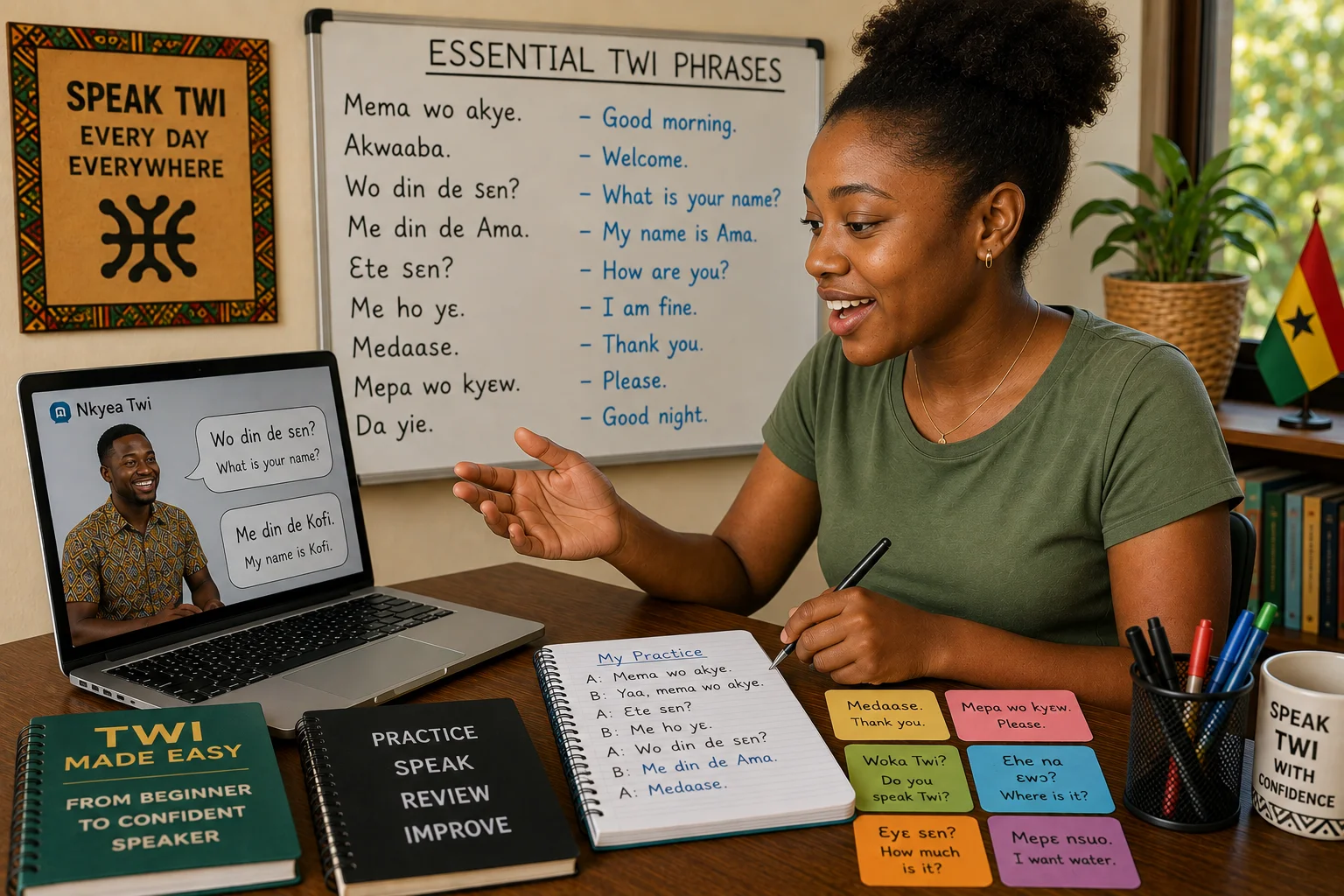
Do not wait until you know hundreds of words. Start with language you can use immediately: hear it, imitate it, understand when to use it and practise saying it without reading.
Start speaking before you feel ready
A common beginner mistake is waiting to learn enough vocabulary and grammar before speaking. A better first goal is much smaller: learn enough Twi to handle a few everyday interactions.
Start with greetings and polite expressions. These are useful almost everywhere and give you an immediate way to interact with Twi speakers.
Do not try to memorise all eight immediately. Choose three or four, listen to them and say them repeatedly until they begin to come naturally.
Learn to introduce yourself
Once you can greet someone, introductions give you your first opportunity to turn a greeting into a conversation.
Learn the small phrases that keep you talking
Some of the most useful beginner Twi is very short. These expressions help you respond quickly instead of becoming stuck while trying to construct a complete sentence.
Learn a few phrases for getting around
If you are learning Twi for a visit to Ghana, transport and directions can quickly become some of your highest-value vocabulary.
Learn enough Twi to buy something
Markets and shops give beginners another useful place to practise because the purpose of the conversation is usually clear.
Add food and drink to your beginner Twi
Food gives you another group of phrases that can be used repeatedly at homes, restaurants, chop bars and other everyday settings.
Learn both sides of the conversation
Knowing how to ask a question is only half the job. You also need to recognise what another person may say back. Practise short exchanges rather than isolated sentences.
Now change the name, reverse the roles or replace the morning greeting with an afternoon greeting. Small variations help move you away from simply reciting a memorised dialogue.
Listen before you trust the spelling
Twi contains sounds and pronunciation patterns that should not be guessed from English spelling. Hear a reliable model first, imitate it and then use the written phrase as a reminder of the sound.
Hear the complete phrase several times at natural speed.
Repeat the sound you hear rather than reading it with English pronunciation habits.
Hide the text and try to produce the phrase yourself.
Put the phrase into a short real or simulated conversation.
Choose the Twi you actually need
You do not need every beginner phrase at once. Build your first vocabulary around the situations you expect to encounter.
Learn the language that helps you move around and handle everyday interactions.
Prepare for the questions and expressions you are likely to hear from relatives.
Start with language that helps you participate in common social and professional situations.
Grammar matters, but it does not have to come first
You can start speaking with complete phrases and gradually learn why those phrases are constructed the way they are. As you progress, learn pronouns, common verbs, tense patterns, questions and sentence construction.
The long-term goal is not to memorise thousands of fixed phrases. It is to use the phrases you already know as examples that help you understand Twi well enough to create your own sentences.
A simple first-week Twi plan
Learn morning, afternoon and evening greetings plus Medaase and Mepa wo kyɛw.
Learn to ask someone's name, give yours and ask where someone is from.
Practise yes, no, I understand, I don't understand and please say it again.
Choose travel, food, shopping, family or another situation that matters to you.
Spend more time listening to phrases you already know instead of adding new ones.
Produce your phrases from memory and practise both sides of short exchanges.
Combine greetings, introductions, questions and responses into one short conversation.
How Nkyea Twi can help you practise
Nkyea Twi is designed to help you move from recognising useful Twi to actually saying it. The app gives you a structured place to listen, speak, review and practise language in context.
Build speaking ability one useful phrase at a time.
Learn useful Twi for greetings, travel, family, shopping, work and everyday conversation.
Hear how phrases are actually pronounced instead of relying on spelling alone.
Say phrases aloud and use AI-powered feedback to guide your speaking practice.
Practise what you will say, what you may hear and how you can respond in real situations.
Review useful language and strengthen your ability to recall it without reading.
Keep returning to useful phrases while gradually expanding what you can understand and say.
Your first target is not fluency
Fluency is too distant to be useful as your first milestone. Instead, aim to handle the opening thirty to sixty seconds of several common interactions.
As a beginner, try to reach the point where you can:
- greet somebody appropriately;
- say your name and ask theirs;
- ask how someone is and recognise a simple reply;
- use Medaase and Mepa wo kyɛw naturally;
- say when you do not understand;
- ask someone to repeat something;
- handle a simple purchase, journey or food interaction;
- recognise likely answers to questions you have learned;
- say useful phrases without reading them; and
- continue a short two- or three-turn conversation.
That is already meaningful progress. Once you can do these things, you are no longer simply studying Twi. You have started using it.
Learn useful Twi. Hear it. Say it. Use it.
Nkyea Twi combines native audio, speaking practice, 2,000+ useful phrases, contextual Missions, smart flashcards and review tools to help you move from learning Twi to actually speaking it.